
It’s a scenario we see often, especially around the holidays in November. You’re preparing your Leesburg home for guests - the kitchen is bustling, lights are on, and the oven is preheating. But when you walk into the living room to turn on the TV, you’re met with silence. A quick check reveals that the lights in the bedroom won’t turn on either. It’s a confusing and frustrating situation: some parts of your house have electricity, while others are completely dark. This is a classic case of having half house power, and it’s more than just an inconvenience; it’s often a symptom of a deeper electrical issue that needs immediate attention.
As a specialist with over a decade of hands-on experience in residential electrical systems, I've diagnosed this problem in countless homes. It can be caused by something as simple as a tripped breaker or as complex as a failing connection from the utility line. Understanding the signs and potential causes is the first step toward safely restoring full power to your home.
Common Signs and Symptoms
When you lose power to only part of your home, the signs can be confusing. You might assume it's just a tripped circuit, but when resetting a breaker doesn't solve the problem, you're likely dealing with a larger issue. The specific partial power outage symptoms can provide important clues about the root cause.
Here’s what our technicians typically look for:
- Distinct Zones of Outage: Power is out in entire sections of your home that don't correspond to a single circuit. For example, the kitchen and a bathroom might work perfectly, while all the bedrooms and the living room are dead.
- Large Appliances Not Working: Your 240-volt appliances, such as the electric stove, water heater, or clothes dryer, may not turn on at all, while your smaller 120-volt appliances (like lamps and TVs) in other rooms seem to work fine. This is a major red flag.
- Flickering or Dimming Lights: You may notice lights in the working parts of your house dimming or flickering, especially when a large appliance like the refrigerator or AC unit kicks on. This can be one of the key loose neutral signs in a home.
- Outlets Working, Lights Not (or Vice Versa): In some cases, the outlets in a room might have power, but the overhead lights don't. This points to a more complex issue than a simple tripped breaker.
- Some Breakers Won't Reset: You may find that one or more breakers in your panel trip and cannot be reset, or they feel “mushy” and don’t click firmly into place.
These symptoms suggest that one of the two main “legs” of power feeding your home has been interrupted. Your home’s electrical service is typically 240 volts, delivered through two 120-volt hot wires and a neutral wire. Different circuits are balanced across these two legs. When one leg fails, all the circuits connected to it go dark.
What Causes This Problem
Diagnosing the cause of a half house power outage requires a systematic approach. While some causes are simple, many are hazardous for a homeowner to investigate without proper training and tools. Here are the most common culprits we encounter during Leesburg electrical repair calls.
- A Tripped Main Breaker Leg: Most modern homes, including many of the Florida Ranch style homes built in Leesburg during the 1990s and 2000s, have a double-pole main breaker at the top of the electrical panel. It looks like two standard breakers connected together. It's possible for one pole (or leg) of this main breaker to trip without the other, cutting power to half the circuits in the panel. Sometimes, the handle won't look fully tripped, making it hard to spot.
- A Failed Breaker: Breakers are mechanical devices that wear out over time. The main breaker or even a breaker on a multi-wire branch circuit can fail internally. In this case, even if it looks like it's on, it may not be making a proper connection, leading to a partial outage.
- A Loose Neutral Connection: This is one of the more dangerous causes. The neutral wire is essential for completing the circuit and maintaining a stable 120 volts. If the main neutral connection coming into your panel becomes loose or corroded, it can create unpredictable voltage fluctuations. You might see lights get extremely bright before burning out, or electronics might be damaged. The loose neutral signs in a home should never be ignored, as this condition can create a serious fire and shock hazard.
- Problems at the Service Drop or Meter: In many Leesburg neighborhoods, power is delivered via overhead lines. The connection point at your roof, called the weatherhead, is exposed to the elements. Over time, corrosion, wind, or even a falling tree branch can damage one of the incoming service conductors. A similar issue can occur at the electric meter base, where the jaws holding the meter can become loose or corroded, causing a poor connection for one leg of your service.
- Utility Company Equipment Failure: The problem may not be on your property at all. A fault at the utility transformer on the pole, a bad connection at the pole, or a damaged underground service line can all cause you to lose one leg of your power. A good first step is to quickly and safely check if your immediate neighbors are experiencing a similar issue. If they are, the problem is almost certainly on the utility side.
- Damaged Internal Wiring: Though less common, it’s possible for a main service wire between the meter and your electrical panel to become damaged. This is a serious issue that requires immediate professional attention.
When to Call a Professional
While it’s tempting to try and fix the problem yourself, electrical work - especially involving your main service - is extremely dangerous. Knowing when to step back and call for help is critical.
A homeowner can safely:
- Check if any neighbors have a similar issue to help determine if it's a utility problem.
- Attempt to reset the main breaker. To do this properly, you must turn the breaker all the way to the “OFF” position and then firmly back to the “ON” position. If it immediately trips again, do not try to reset it again.
You should call a qualified professional immediately if:
- Resetting the main breaker doesn't restore power.
- You notice any signs of a loose neutral, such as lights getting very bright or dimming erratically.
- You smell burning plastic or hear buzzing or crackling sounds from your electrical panel.
- You are not 100% comfortable or knowledgeable about working with your electrical panel.
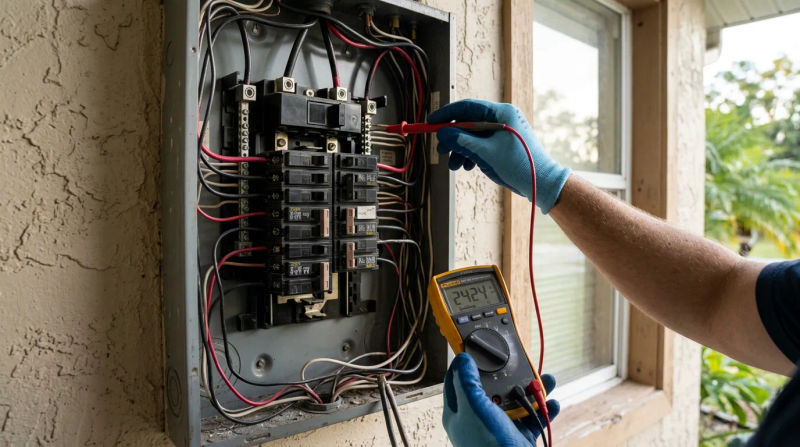
Our trained technicians use specialized diagnostic tools like multimeters and circuit tracers to safely pinpoint the exact cause of a partial power outage. We can determine if the issue is a failed breaker, a loose connection in the panel, a problem at the meter base, or an issue with the service drop. Attempting to diagnose these issues without the right equipment and safety protocols can lead to severe injury or make the problem worse.
Conclusion
A partial power outage is your home’s way of signaling a significant electrical problem. While it could be a simple tripped breaker, it often points to a more serious issue like a failed service connection or a hazardous loose neutral wire. Especially as we gather with family and increase our home's electrical demand during the holiday season, addressing these symptoms promptly is crucial for your safety and peace of mind.
Don't wait for a partial outage to become a complete failure or a safety emergency. Pay attention to the partial power outage symptoms, and remember that anything beyond a simple breaker reset requires the expertise of a trained professional.
If you notice any of these signs, contact a local electrician for a thorough inspection and repair.